Sunday, July 27, 2014

Meet the Author, Liesa Malik-- Book Signing Event at the LAC


Liesa Malik relays to her gathered audience that it is widely regarded that the most influential invention ever to affect modern man was the movable-type printing press, developed by Johannes Gutenberg in 1439.  Allowing for mass communication, an increase in education and literacy, inspiration and entertainment permanently altered the structure of society.  This fact, along with a discussion of digital vs. hardcopy books, recycling, repurposing paper tomes, a trivia game on mystery tv shows, origami and helpful hints on setting up a still life with books, 

all accompanied her book signing and reading event at the LAC Saturday afternoon.  Oh, and did I mention she’s not only a published author, but a talented artist as well?

To get the attendees excited about the mystery genre, Liesa had collected trivia questions on mystery and crime-solving tv shows from current day all the way back to the 1960’s. A Milky Way candy bar was the prize for a correct answer.  Three correct answers shouted out despite a mouthful of chocolate garnered the grand prize of a free copy of her novel.  Who would’ve guessed remembering Allyce Beasley as Ms. Dipesto jabbering jingles on “Moonlighting” would have won me the prize? 
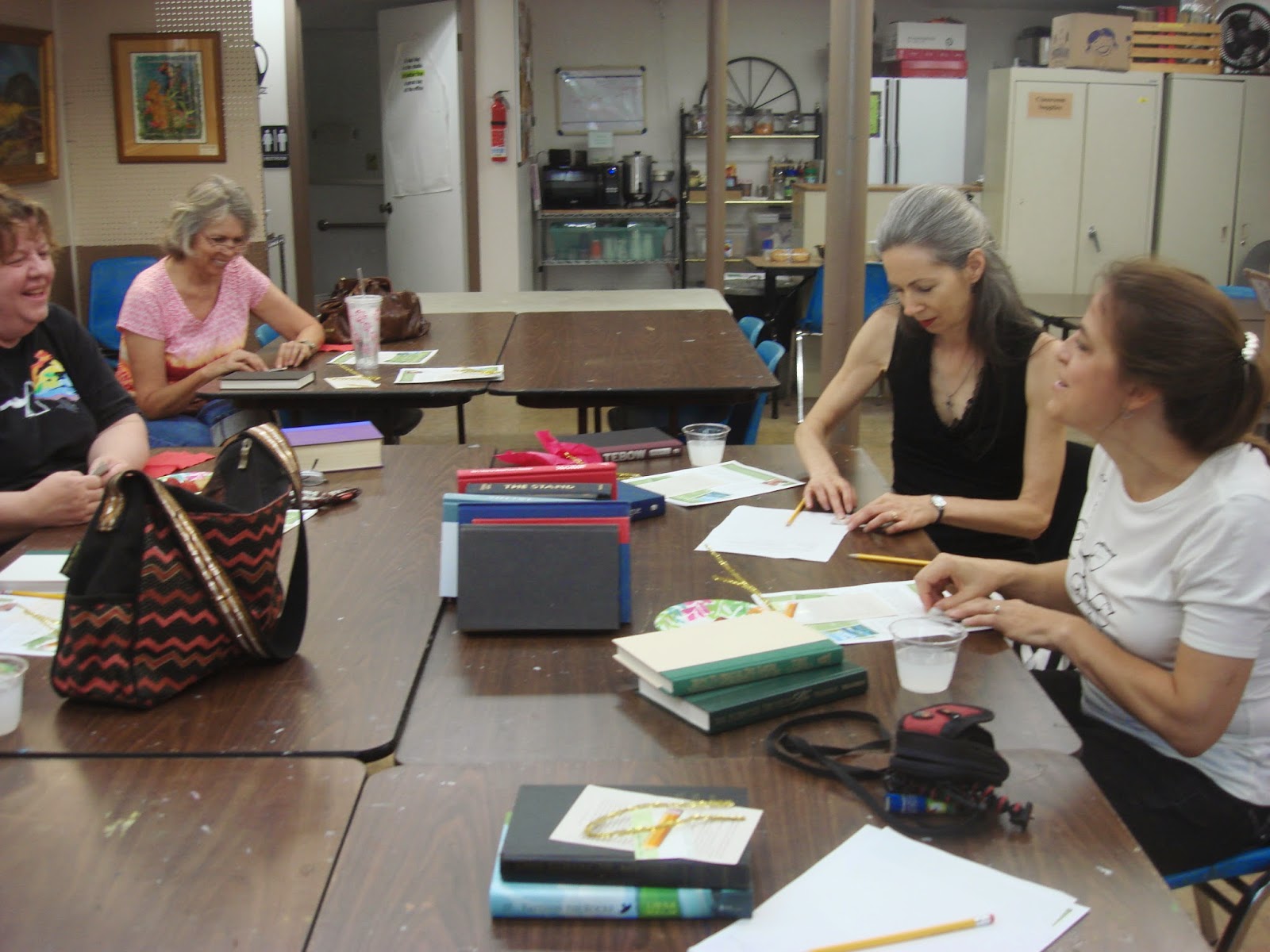
 
What fun we all had learning to fold heart-shaped origami bookmarks, learning about the “altered-books” artform, and trying our hands at folding designs in thrift store hardback cast-offs while Liesa read to us from her first-in-a-series of Daisy Arthur Mystery Stories, “Faith on the Rocks”. 


 Chapter one starts off with Daisy’s writing group finding out one of its own has been found murdered.  Place names in the book are all locations within Littleton, so it’s fun visualizing these familiar locales.  While we finished up our page-folding projects, Liesa managed sales and signed books, kindly donating a portion of the proceeds to the LAC.  

After enjoying too many cookies (did I really need those in addition to chocolate bars?) I headed home with my personalized copy of “Faith on the Rocks” and delved into it.  Liesa’s fun writing style, informative passages and development of intrigue definitely caught my attention.  What a great way to spend my Saturday evening and Sunday afternoon, sitting on the patio reading her novel. 

 Liesa is available to visit your group or book club.  Contact her at LiesaMalik.Wordpress.com.  I know she will keep you happily entertained!  Thank goodness for that printing press!

Saturday, July 12, 2014

Summer Colors Exhibit

Stop by the LAC Gallery to see the "Summer Colors" exhibit, on view now through August 1. Here's just a sampling of pieces from the upstairs and downstairs shows. 

Sunday, June 22, 2014

2014 Garden Tour


Flowers and vegetables, garden art, a lively puppy and even a horse were the attractions at the Lakewood Arts Council’s Annual Garden Tour Benefit on Saturday, June 21.   

Six homeowners in the Wheatridge, Golden and Lakewood area offered up their well-tended gardens to the delight of LAC and other community members. 


 LAC volunteers manned front entrances to the garden, helped homeowners answer gardening questions from the public,  and organized a delicious luncheon  and garden-craft making session at the Art Center and Gallery which was included in the ticket price. 


While at the Gallery, visitors were treated to an exhibit of wall-hung, garden-themed artwork by local artists as well as an opportunity to purchase indoor or outdoor plants at the plant sale.

Highlights of the event this year included a rare tour of the Cason Howell House, which is on the Colorado State Register of Historic Properties.  The property is currently owned by the City of Lakewood and functions as a community center for the residents of Willow Glen Senior Housing.  A tour of their private courtyard revealed raised beds full of flourishing vegetables and flowers. 

A beautiful Tudor style brick home in Lakewood offered a charming front yard cottage garden, along with an agreeable horse, playful puppy and cute cat. 


 Interesting garden art crafted from found objects, twigs and twine graced the walls at the Lakewood home of a landscape architect,

 while bird houses, vine covered arbors and benches amongst  the flora provided spots to rest and enjoy the sights at homes in Wheatridge and Golden.

 The annual Garden Tour is a main fundraiser for the Lakewood Arts Council, a non-profit arts organization.  To find out more about the LAC, or to join them next year for the Garden Tour as spectator or participant, please visit the Art Center and Gallery at 85 S. Union Blvd in Lakewood, call 303 980-0625 or visit www.lakewoodartscouncil.org.
Photo credits:  Gail Firmin and Ann Quinn

Friday, June 13, 2014

Watercolor Batik Workshop with Cheryl Annett

Cheryl had a great turnout for her watercolor batik workshop on Friday, June 13th.  Working on gold-threaded rice paper, students first chose their subject, then outlined the image on the rice paper.  Using hot wax as a resist to save any white areas, colors were then painted on, more wax added and continuing in this manner until a desired result was obtained.
Cheryl demonstrated these techniques for the students, and had examples of her own work on display,
as well as a work in its different progressions.

The students had a great time learning a new technique and enjoying successful results!

Wednesday, June 4, 2014

The Guerrilla Painter

Carl Judson pulled up to the LAC in his "Moby Van" full of plein air equipment and  variety of art supplies.
 
 He visits plein air events and artist groups to talk about his Guerrilla Painter Pochade Boxes.  With a group of 9 or 10 artists in attendance, Carl explained a bit about how he got into this business after being a manager of a cattle ranch.  He had read an essay by Winston Chruchill that promoted painting as a way to ease stress.  Taking up painting but not wanting to be subject to cowboy critics, he would pack his supplies away quickly in a homemade box that fit under the seat of his truck.  Secretly capturing views of the world in this manner, with his little supply box, helped him coin the term "Guerrilla Painter" and thus was born Guerrilla Painter Pochade Boxes.

Carl emphasized the importance of having all supplies neatly at hand.  He's a part-time painter and wouldn't do it if it required too much set up time and array of supplies.  His small boxes expand the opportunities for painting.  The simplest solution is to buy the least amount of supplies you need, he says.

A slide presentation then highlighted the works of some well-known and some not so well-known plein air artists from Pierre-Henri de Valenciennes, probably the first known artist to practice plein air painting as a discipline in the 1700's,

to the landscapes of Georgia O'Keefe. 

Not all of the artworks depicted beautiful outdoor scenes -- what one expects of a plein air work, as is the case with Audobon, who would shoot the birds he wanted as subjects, set them up in an outdoor scene, then paint them.  The mundane subject of a simple toolbox belonging to coal miners was painted by the Pittman Painters, simple beauty in its own right, but not the typical sweeping landscape expected in plein air works.  "One of our tasks as an artist is to describe the less obvious beauty in life", says Carl.  And with his convenient products, he makes that easier to do. His website is www.guerrillapainter.com


Tuesday, May 13, 2014

The Artist's Curse


Drawing: The Art of Seeing is the name of the basic drawing class I teach for the City of Lakewood.  I thought it a funny name at first, but realized that to draw or paint effectively is really a function of seeing properly.  So many times I’ve witnessed a beginning student try to draw an object in front of them and they wind up drawing what they think they are seeing, not what the object actually looks like.  This is because we all have pre-conceived notions of what items look like.  And, I’ve read, the average adult has the drawing abilities of a 9 year old.  So a flower turns out to be a circle with symmetrical petals on a straight stalk, a cat becomes a circle with triangle ears and so on.  And now I know why my husband’s simple attempts at conveying an idea in Pictionary are usually more effective than my detailed efforts!

With all this emphasis on proper observation, a quick walk in the park can turn into an enthusiastic photo session when the flowers are in bloom and digital cameras make snapping away easy.  On a recent trip to Vancouver, BC to see my son, he took us to Queen Elizabeth Park, where gorgeous tulips stood in rows and rhododendron blossoms sparkled with water droplets from the recent rain. 


 Overcast skies softened shadows – a photographer’s ideal lighting.  Of course I had to take multiple shots of everything, close-ups of the rhodies with the light diffused through the petals, long shots of the city framed by white flowering bushes, 

 shots from ground level, multiple photos from different angles – everything looking to me like a potential painting.  That’s the artist’s curse, you see with an artist’s eye – how the lights hits a leaf, how the colors change within a petal, how a tree casts an interesting shadow, and feel the need to capture all these observations on paper, canvas or with a photo.  


I must say my family is pretty understanding with my obsession, and even wait for me to catch up to them on the pathway in the park.  At least they’re taking time to smell the roses while I photograph them!

Saturday, April 19, 2014

Book Discussion of "Housekeeping"

I attended the Lighthouse Writers Workshop facilitated book discussion group on Friday, April 18, along with a number of LAC members and other participants interested in literature.  The book being discussed was Marilynne Robinson's "Housekeeping".  A National Endowment of the Arts grant to the Lighthouse Writers Workshop allowed for distribution of free copies to organizations such as the LAC, which participated in the "Big Read".  Books were available at the gallery in February, and takers were encouraged to sign up for the book discussion event.

"Housekeeping", according to the accompanying reader's guide, is a book about "the precarious and eccentric lives of three generations of Foster family women.  "Housekeeping" chronicles the deaths, abandonments and insecurities that beset the Fosters so vividly that it is often heartbreaking, but the novel also radiates a mysterious joy and tender humor commensurate with Ruth's childlike capacity for the sheer wonder of being alive."

Dan Manzanares, Creative Curator and staff member of the LWW, and educated in the literary arts, led a "generative" session for our book discussion which delved into the meaning, mechanics and mental images of the novel.  This generative approach was achieved by four different prompts, asking us to respond by sketching our reaction, or writing a brief response.

The first prompt asked us to use our imagination to draw or write about what we might find if we dipped a net into the hole in the icy lake that resulted from the derailment of the passenger train from the bridge in the book's setting of Fingerbone, Idaho. I was very moved by the images created by the participants in the discussion group -- either by their written responses which suggested stories in themselves, or the drawn images showing children's clothes, toys, or a hat to be worn on an anticipated vacation.

In prompt #2, we examined a mysterious section of the book which made us question reality and how it is experienced by Ruthie and Sylvie, the two main characters.

Water was an all-encompassing theme in this book, in all its forms: ice, snow, flood, rain, lakewater.  As a metaphor for consciousness, we again examined a section of the book and visually or literally recorded our response to it.  And lastly, speculations were shared: the author's methods, mechanics, our thoughts on how the book fit into the events of the time period.  Although consensus was that it presented a dreary overtone, with a lack of plot, her writing was lyrical and enjoyable to experience and the discussion session was beneficial in not only understanding  the book itself, but made us examine our own reactions to it.

The LAC was delighted to participate in the "Big Read" program, an initiative of the NEA designed to revitalize the role of literary reading in American Popular culture.  In expanding our literary outreach, the LAC hopes to bring you more opportunities to participate in these types of activities.  Check our calendar for upcoming events.